Tiny homes aren’t just about downsizing, they’re about right-sizing. Whether you’re drawn to the movement for financial freedom, environmental reasons, or pure simplicity, understanding size standards is the first step to building or buying smart. Tiny homes range wildly in square footage, and those differences directly impact what you can fit, where you can park, and what regulations apply. This guide breaks down the standard dimensions, size categories, and legal considerations so you can plan a tiny home that actually works for your life.
Table of Contents
ToggleKey Takeaways
- The most widely recognized tiny home size standard is 400 square feet or less, according to the International Residential Code (IRC) Appendix Q, though some areas extend this to 500-600 square feet.
- Tiny homes on wheels typically measure 8 to 8.5 feet wide and 12 to 28 feet long, translating to 100-240 square feet on the main floor plus 40-80 square feet in sleeping lofts, while foundation-built models offer more flexibility in footprint design.
- Standard tiny homes between 150-400 square feet offer the best balance of livability, accommodating a full kitchen, bathroom, living area, and one or two sleeping lofts comfortably.
- Zoning laws vary dramatically by jurisdiction, and tiny home size directly determines legal placement, with many municipalities requiring minimum square footage of 600-1,000 feet for permanent dwellings, making Accessory Dwelling Unit (ADU) ordinances the most common workaround.
- Livability in a tiny home size depends more on smart design features—vertical storage, natural light, adequate ceiling height, and elimination of hallways—than raw square footage alone.
What Is Considered a Tiny Home? Standard Size Definitions
There’s no single legal definition of a “tiny home,” but the industry has settled on practical benchmarks. The International Residential Code (IRC) Appendix Q, adopted in many jurisdictions, defines a tiny house as a dwelling 400 square feet or less, excluding lofts. That’s the most widely referenced standard.
Some advocates extend the definition to 500 or even 600 square feet, particularly for foundation-built tiny homes. For comparison, the average new single-family home in the U.S. sits around 2,200 square feet, roughly five to six times larger.
Tiny homes fall into two structural categories: tiny houses on wheels (THOWs) and foundation-built tiny homes. THOWs are typically built on trailers and classified as RVs or park models if they meet RVIA or NOAH standards. Foundation-built models follow traditional building codes but must comply with local minimum square footage requirements, which vary widely.
If your tiny home exceeds 400 square feet, it may face different zoning, insurance, and financing rules. Always verify local definitions before you commit to a size.
Average Tiny Home Dimensions and Square Footage
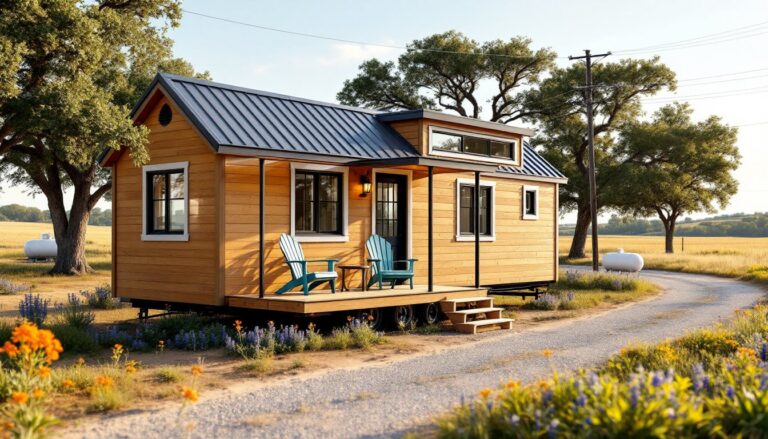
Most tiny homes on wheels measure 8 to 8.5 feet wide by 12 to 28 feet long, with interior heights around 13 to 13.5 feet to accommodate lofts. That translates to roughly 100 to 240 square feet of main-floor space, with an additional 40 to 80 square feet in sleeping lofts.
Width is typically capped at 8.5 feet to avoid needing an oversize load permit for road transport. Length maxes out at 28 feet for most trailer frames, though some custom builds stretch to 32 or even 40 feet, those require escort vehicles and special hauling permits.
Foundation-built tiny homes have more flexibility. Common footprints include 12×20 feet (240 sq ft), 16×20 feet (320 sq ft), and 20×20 feet (400 sq ft). Ceiling heights typically run 8 to 10 feet, though vaulted or shed-style roofs can add vertical space without increasing the footprint.
Keep in mind that square footage calculations vary. Some builders count lofts if headroom exceeds 5 feet: others don’t. Porches, decks, and bump-outs may or may not factor in depending on your jurisdiction.
Popular Tiny Home Size Categories
Micro Tiny Homes (Under 150 Square Feet)
Micro tiny homes prioritize extreme minimalism. These builds often measure 8×12 to 8×16 feet and function more like mobile studios than traditional houses. They suit solo dwellers, weekend retreats, or backyard guest units.
Storage becomes critical here. Expect built-in cabinetry, Murphy beds, fold-down tables, and multi-function furniture. Many micro builds skip full kitchens in favor of a two-burner cooktop, mini fridge, and portable sink. Bathrooms are typically wet baths (shower and toilet share the same waterproofed space) measuring around 3×4 feet.
Micro homes work well for off-grid setups since heating, cooling, and power demands stay low. A 2,000-watt solar array can often handle the load. But livability drops fast if you’re storing anything beyond the essentials or hosting guests.
Standard Tiny Homes (150-400 Square Feet)
This is the sweet spot for most tiny home buyers. A 200 to 300 square foot layout can comfortably include a full kitchen, bathroom with a standard shower, living area, and one or two sleeping lofts.
Kitchens in this range often feature apartment-size appliances: an 18 to 24-inch range, 10 to 12 cubic foot refrigerator, and a compact dishwasher. Countertop space runs tight, but butcher block extensions or fold-out sections add prep room when needed.
Bathrooms upgrade to separate shower stalls (30×30 or 32×36 inches) and sometimes a small vanity. Composting toilets are common in THOWs to avoid black water tanks: foundation builds typically connect to standard septic or sewer.
Lofts in standard tiny homes usually max out at 42 to 48 inches of headroom, enough to sit up but not stand. Access is via ladder, ship stairs (alternating tread), or narrow staircases if floor space allows. For anyone with mobility concerns, ground-floor sleeping is worth the tradeoff in storage.
Heating and cooling scale with size. A mini-split heat pump (9,000 to 12,000 BTU) handles most climates efficiently. Insulation matters more than square footage, use closed-cell spray foam or rigid foam panels to hit R-13 walls and R-30 roofs.
How Tiny Home Size Affects Livability and Functionality
Size directly dictates how you move, cook, sleep, and store belongings. A 100-square-foot micro home forces radical decluttering: a 350-square-foot model offers breathing room without sacrificing the tiny lifestyle.
Traffic flow becomes critical in smaller footprints. Doorways should be at least 30 inches wide (32 is better) to avoid bottlenecks. Hallways eat up precious space, most tiny homes eliminate them entirely by arranging rooms in a single line or L-shape.
Storage volume scales slower than floor area. A 200-square-foot home doesn’t have twice the storage of a 100-square-foot one. Vertical space, under-stair compartments, and built-in benches with lift tops become essential. Many successful tiny home dwellers carry out decluttering strategies to keep possessions under control.
Natural light impacts perceived spaciousness more than actual measurements. Prioritize windows on at least two walls, and consider skylights or clerestory windows in lofts. A well-lit 150-square-foot space feels larger than a dim 250-square-foot one.
Ceiling height also matters. An 8-foot ceiling over the main living area feels tight: bump it to 9 or 10 feet and the space opens up. Lofts with less than 40 inches of headroom work for sleeping but feel claustrophobic for anything else.
For couples or families, aim for at least 250 to 300 square feet to maintain sanity. Separate sleeping zones (even if just curtain-divided lofts) prevent constant togetherness from turning into friction.
Legal Size Restrictions and Zoning Considerations
Zoning codes vary wildly by jurisdiction, and tiny home size directly affects where you can legally place one. Many municipalities enforce minimum square footage requirements for permanent dwellings, often 600 to 1,000 square feet, which automatically excludes most tiny homes from standard residential lots.
Accessory Dwelling Unit (ADU) ordinances offer the most common workaround. ADUs, also called granny flats or backyard cottages, typically allow structures between 400 and 800 square feet on single-family lots, provided the main house remains the primary residence. Check setback requirements (usually 5 to 10 feet from property lines) and lot coverage limits (often 50 to 60 percent maximum).
Tiny houses on wheels face separate challenges. Because they’re built on trailers, many jurisdictions classify them as RVs or park models, which are prohibited in residential zones. Some areas allow THOWs in RV parks or designated tiny home communities but ban them from private property.
A handful of progressive cities, Portland, Austin, Fresno, have adopted tiny-home-specific zoning. These codes recognize structures under 400 square feet as legal dwellings if they meet IRC Appendix Q standards (minimum ceiling heights, egress windows, stair dimensions, etc.).
Building permits depend on size and foundation type. Foundation-built tiny homes almost always require permits and inspections. THOWs sometimes dodge permitting if classified as temporary structures, but that often means no legal electrical or plumbing hookups.
Before selecting a size, research your local codes or consult a zoning attorney. A 399-square-foot home might be legal while a 401-square-foot one isn’t. Tiny home designs often take inspiration from modern prefab concepts and small-space living solutions, blending efficiency with style.
Utility connections also hinge on size and classification. Permanent structures need code-compliant electrical service (usually 100-amp minimum), water supply, and waste disposal. Off-grid systems bypass some regulations but may limit financing or resale options.
If you plan to move your tiny home, keep width at or under 8.5 feet and length under 28 feet to avoid costly permits and pilot cars. Oversize loads require advance route approval, which some states restrict or deny entirely.